
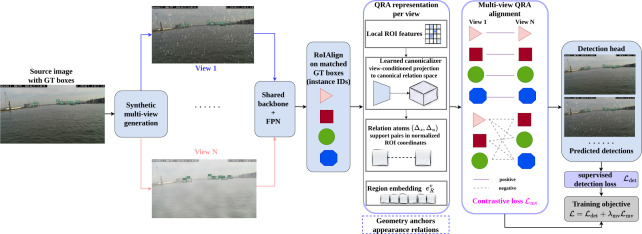
Reliable object detection is essential for the safe and autonomous operation of Unmanned Surface Vehicles (USVs). However, AI-based detection systems trained in one maritime environment often struggle when deployed in unfamiliar conditions, where differences in water appearance, lighting, weather, and geographical surroundings can significantly affect their performance. Addressing this challenge, researchers from IDLab at the University of Antwerp have developed a novel approach to improve the generalization of object detection systems across diverse maritime environments.
The study introduces Quotient Relational Alignment (QRA), a learning framework that enables AI models to detect maritime objects more reliably in previously unseen environments. The approach generates multiple variations of training images and encourages the model to learn consistent structural relationships within objects, rather than relying primarily on visual appearance. This allows the model to better distinguish vessels and navigational markers despite changes in environmental conditions.
To evaluate the approach, researchers trained the model using a single maritime dataset and tested it on five independent datasets covering sea, lake, canal, and river environments, including inland waterways in Antwerp, Belgium. The proposed method achieved an average detection accuracy of 25.2% (mAP@0.5), compared with 22.0% for the baseline Faster R-CNN detector and 23.2% for the strongest evaluated domain generalization baseline. These results demonstrate improved cross-environment detection performance without requiring additional training data from the target environments.
Impact for the Maritime Sector
As autonomous maritime operations expand, robust AI-based perception systems are becoming increasingly important for safe navigation, collision avoidance, and environmental monitoring. The proposed approach contributes to the development of more adaptable object detection systems that can operate across different maritime environments while reducing dependence on extensive location-specific training datasets. These findings represent a step toward more reliable perception for autonomous vessels, although further onboard validation is needed before operational deployment.
Research article: Single domain generalization for object detection in Unmanned Surface Vehicles through quotient-based multi-view relational alignment, Ocean Engineering (2026)
Authors: Linh Trinh, Jens Duym, Siegfried Mercelis, and Ali Anwar
Code, data, and model weights: https://gitlab.ilabt.imec.be/ltrinh/mvqra
Read more about Pilot Project 3: AI-Supported Autonomous Shipping.