
Results from Pilot project 3 were presented at the Tenth International Workshop on Pattern Recognition (SPIE IWPR 2025) in Singapore. The paper is published in Proceedings of SPIE, Volume 13819.
Large language models such as GPT-4o can now read images as well as text, which raises a practical question: can a general-purpose AI do a specialized job like estimating sea state? The team tested this against deep learning models built for the task.
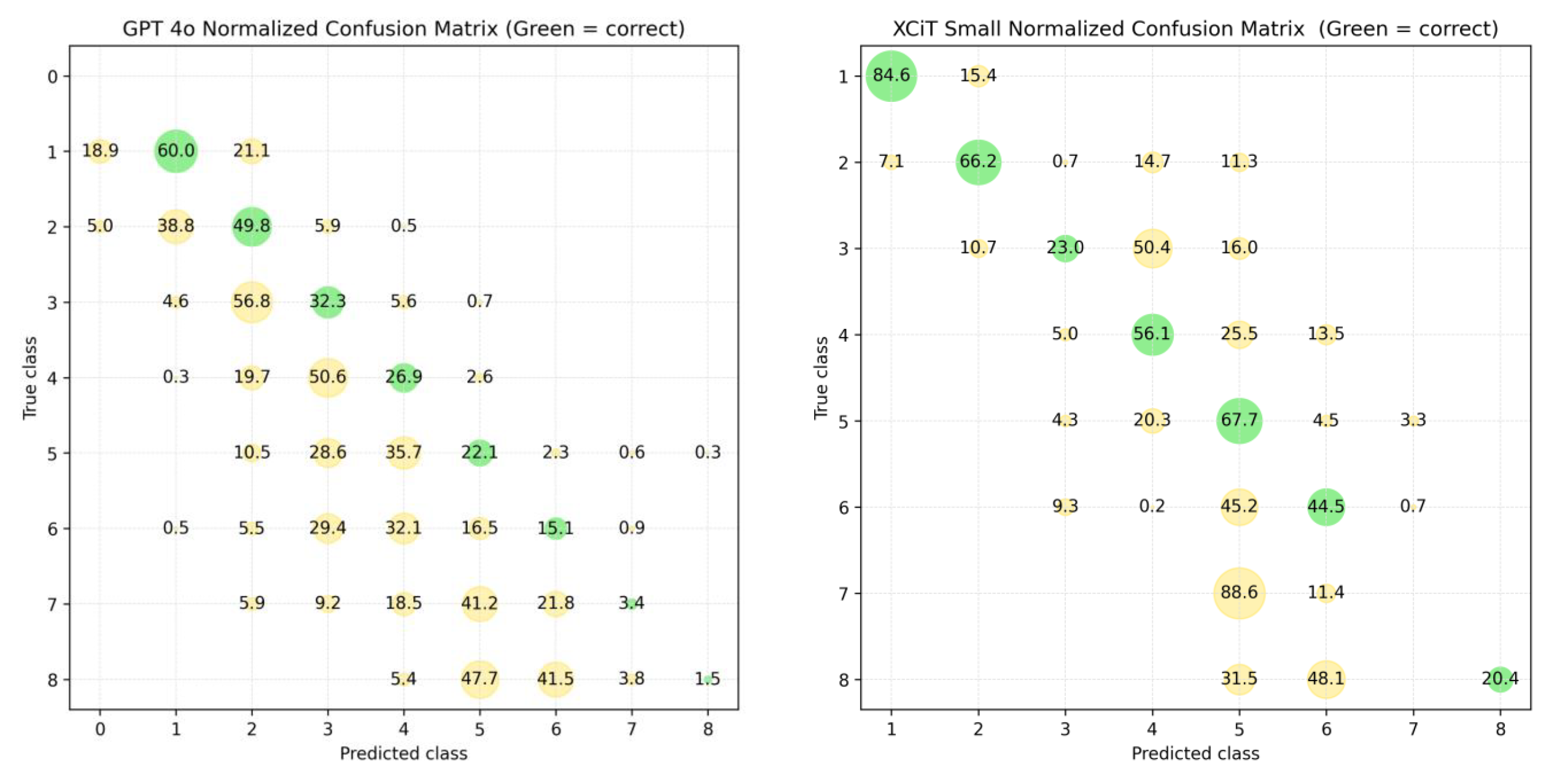
Three specialized models (ResNet101d, XCiT-small and Swin Base) were fine-tuned on images taken from ocean-going ships to recognize Beaufort sea states 1 to 8. They were then compared with OpenAI’s GPT-4o on a newly created test set.
After calibration, GPT-4o gave some encouraging results. The specialized models were still better and more consistent on every metric, and they ran fast enough for real-time use. Swin Base reached the highest F1 score at 46.62%, against 27% for calibrated GPT-4o. ResNet101d had the lowest mean absolute error, 0.738, compared with 0.842 for GPT-4o.
Impact for the Maritime Sector
General-purpose AI is improving fast, but for operational tasks like on-board sea state monitoring, purpose-trained models remain the more accurate, reliable and efficient choice.
Read the full paper: Proceedings of SPIE, Volume 13819