
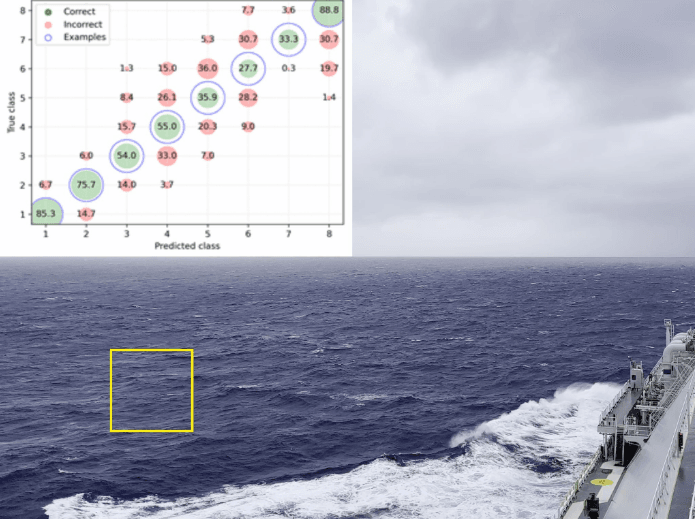
Accurate sea state estimation is critical for ensuring safe and efficient maritime operations. Traditionally, the Beaufort scale, a visual method that links wind speed to sea conditions, is used to classify sea state, but it is subjective and prone to human error. To address this, researchers have developed an automated, real-time approach for localized sea state estimation using a single camera mounted on a ship’s bridge, offering a reliable and objective alternative.
The approach relies on deep neural networks trained on a labeled dataset of sea surface images collected during normal operation of an overseas liner. To improve robustness and operational coverage, the researchers expanded the test set significantly compared to previous studies, enabling a more comprehensive evaluation under diverse navigation and environmental conditions.
Recognizing the challenge of capturing rarely occurring sea states, the team generated a synthetic training datasetsimulating a wide range of sea and weather conditions. This approach increased variability in illumination and wave appearance while preserving realism, enhancing the models’ ability to generalize to real-world conditions.
The study evaluated several state-of-the-art architectures, including ResNet-101d, DeiT III, Swin Transformer, XCiT, and CoAtNet. By systematically adjusting the ratio of synthetic-to-real training data in both RGB and grayscale domains, the researchers achieved a 6% improvement in test accuracy and mean F1 score, while reducing the maximum error from 7 to 3 on the Beaufort scale.
To further improve reliability, a temporal voting framework was introduced, aggregating predictions over consecutive frames. This reduced the maximum error to just 2 Beaufort, achieving 96% intra-1-class accuracy and an F1 score of 62%, significantly outperforming models trained solely on real data without temporal voting.
Impact for the Maritime Sector
The maritime industry is increasingly leveraging artificial intelligence to enhance operational efficiency, navigational safety, and sustainability. Automated sea state estimation provides an objective, real-time monitoring tool that can improve decision-making on ship bridges, reduce human error, and optimize operational planning in varying environmental conditions. The models developed in this study demonstrate a promising step toward robust, AI-driven sea state monitoring.
Read article at the link : Article