
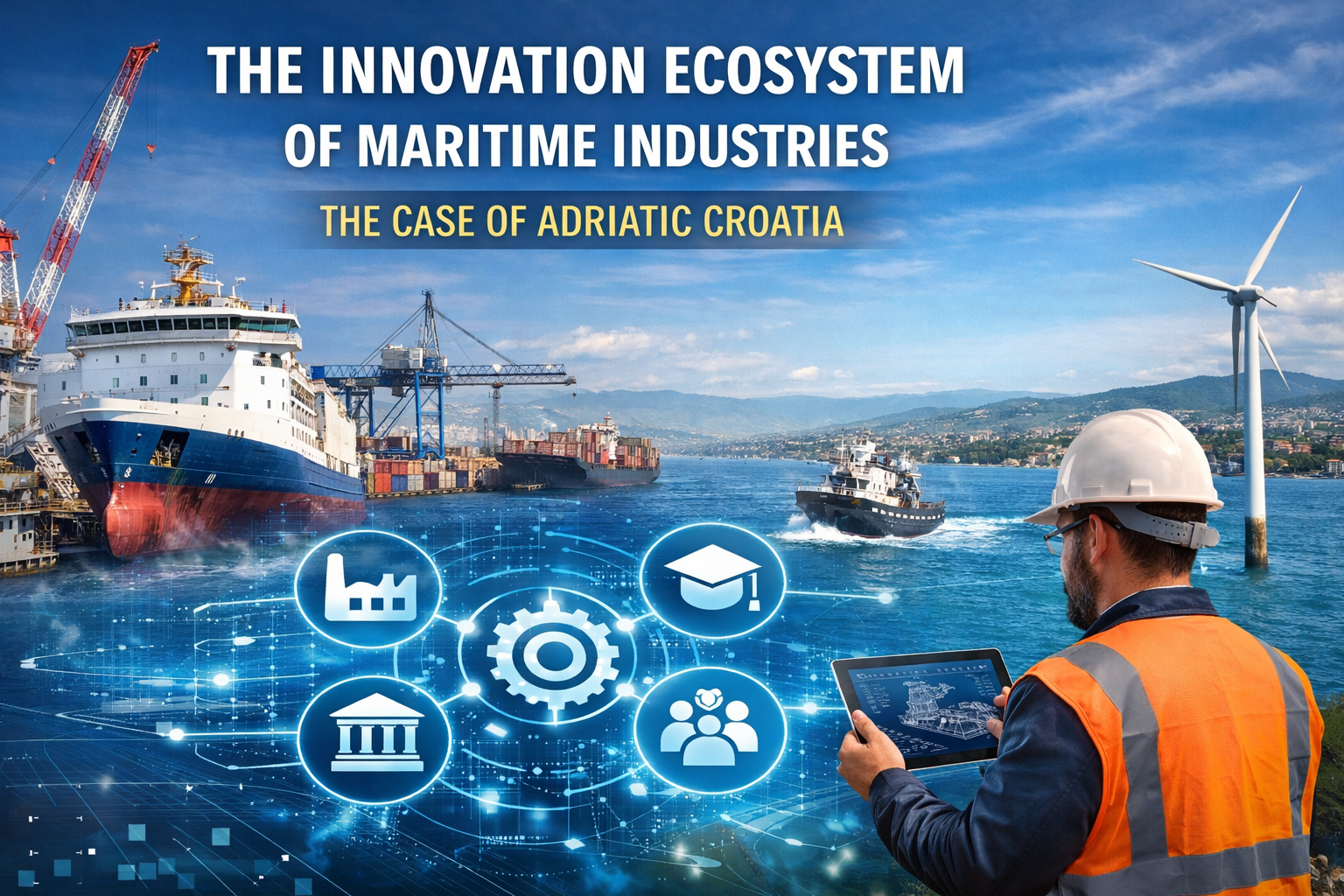
A new scientific publication developed within the INNO2MARE project presents a comprehensive analysis of the maritime innovation ecosystem in Adriatic Croatia, highlighting its structure, key stakeholders, and contribution to regional economic development.
The paper titled “The Innovation Ecosystem of Maritime Industries – The Case of the Adriatic Croatia” was presented at the 15th FEBST International Conference on “Economic Policies, Business Perspectives, and Sustainability Transformation”, held in Brela, Croatia. The research was presented by Nikolina Pomenić from PRIGODA, a consortium partner in the INNO2MARE project.
The study explores how maritime industries—one of the region’s traditional economic strengths—are evolving through innovation, collaboration, and international integration. Using the Quadruple Helix model, the research maps the interaction between industry, academia, government, and society in shaping the maritime innovation ecosystem.
Researchers identified 285 stakeholders operating within the ecosystem, including 261 companies, universities, public institutions, and civil society organizations. The findings show that the ecosystem is strongly industry-driven, with production activities such as shipbuilding, marine engineering, and equipment manufacturing representing nearly half of all stakeholders.
Design offices and specialized SMEs play a crucial role in driving innovation through advanced technologies, digital design tools, and customized vessel solutions. Despite representing a relatively small share of total companies in the region, maritime firms contribute significantly to employment, exports, and productivity, demonstrating strong international orientation and high value creation per employee.
The research also highlights several challenges that limit the ecosystem’s full potential. These include fragmented communication among stakeholders, limited collaboration between academia and industry, shortages of highly skilled professionals, and technological constraints in parts of the shipbuilding sector. At the same time, EU funding opportunities, international cooperation, and the growing demand for sustainable and digital maritime solutions are identified as key drivers for future innovation.
Overall, the study concludes that the Adriatic maritime innovation ecosystem is emerging but promising, with strong industrial foundations and increasing opportunities for collaboration. Strengthening connections among stakeholders and fostering a stronger innovation culture will be essential for supporting the green and digital transformation of maritime industries in the region.
The publication contributes to the broader objectives of the INNO2MARE project, which aims to strengthen innovation ecosystems in maritime regions of Croatia and Slovenia and support the transition toward a sustainable and competitive Blue Economy.
Read article at the link: 15th FEBST Proceedings