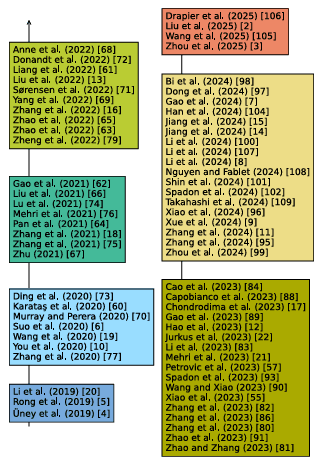
Researchers from the University of Rijeka and the University of Ljubljana have published a comprehensive review article examining the latest advances in maritime vessel trajectory forecasting, one of the fastest-growing research areas in intelligent maritime transportation. The paper, Forecasting Maritime Vessel Trajectories: A Comprehensive Review of Data-Driven Approaches< /em>, has been published in the Journal of Marine Science and Technology. The publication is also an important scientific outcome of the Pilot Project 3, which focuses on the development and application of advanced artificial intelligence methods for maritime data analysis and trajectory prediction.
The review analyses 67 scientific studies published between 2019 and 2025 and highlights the rapid evolution of maritime forecasting technologies. As global shipping traffic continues to increase, accurate prediction of vessel movements is becoming essential for navigation safety, collision avoidance, port operations, autonomous shipping, and maritime traffic management.
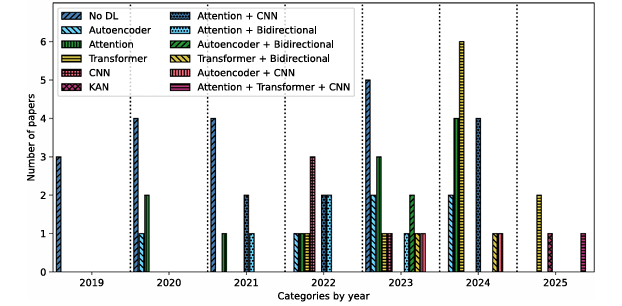
The authors show that the field has moved from traditional statistical and probabilistic methods toward advanced artificial intelligence solutions. Deep learning architectures, particularly Long Short-Term Memory (LSTM) networks, Gated Recurrent Units (GRU), Transformer models, and Graph Neural Networks (GNNs), now dominate state-of-the-art research due to their ability to model complex vessel behaviours and long-term movement patterns.
A key finding of the review is the growing success of Transformer-based and graph-based approaches, which achieve superior performance in modeling vessel interactions and forecasting trajectories in crowded and dynamic maritime environments. The study also identifies emerging trends such as explainable AI, hybrid forecasting architectures, and the integration of environmental information including weather, waves, currents, and sea-state conditions.
The paper further discusses current challenges, including AIS data quality, GNSS interference, spoofing attacks, and the limited availability of standardized open datasets. According to the authors, future research should focus on developing more robust, explainable, and computationally efficient forecasting systems capable of supporting real-world maritime operations.
This review provides researchers and industry professionals with a valuable roadmap for the development of next-generation intelligent maritime navigation systems and highlights the increasing role of artificial intelligence in enhancing maritime safety, operational efficiency, and decision-making at sea. The findings will support future activities within Pilot Project 3 and contribute to ongoing research efforts aimed at creating safer, smarter, and more sustainable maritime transport systems.
Read article at the link : Article