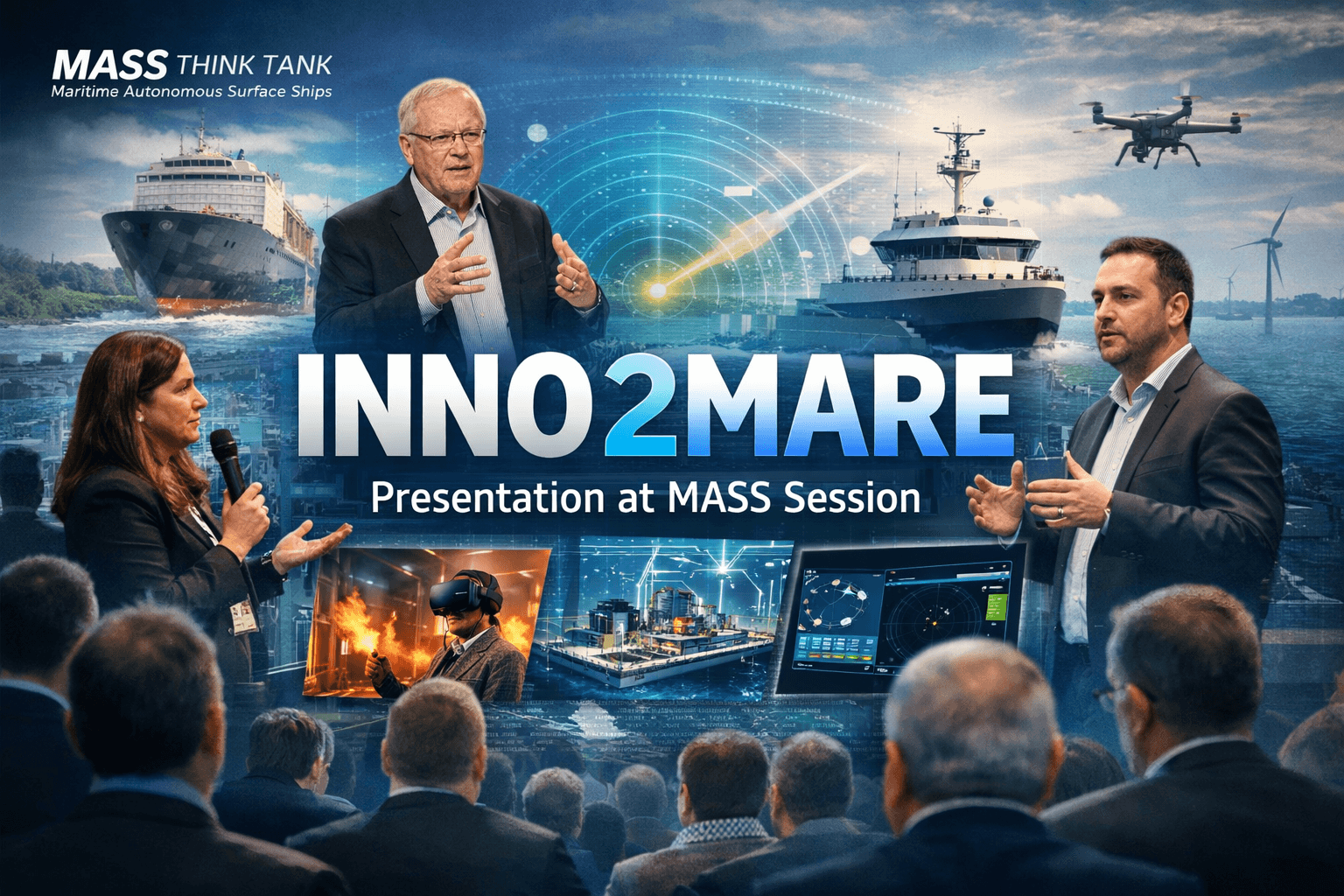
The MASS Community session, organized by the MASS Think Tank (Maritime Autonomous Surface Ships, https://mass.kbrv.be/ ), took place on Friday, 27 March in Antwerp. Bringing together stakeholders from the Flemish and European maritime industry, alongside representatives of Belgian and Flemish public authorities and academic institutions, the event provided an excellent platform for knowledge exchange, dissemination, and networking. For the INNO2MARE project, it offered a valuable opportunity to connect with diverse innovation ecosystems.
The session opened with a presentation by Prof. Evert Lataire, Naval Architect and Professor at Ghent University and Antwerp Maritime Academy, who explored the complexities of ship maneuvering. He highlighted that navigating vessel, particularly on rivers and canals, is fundamentally different from driving cars. Due to hydrodynamic effects, a ship’s effective mass varies depending on water depth and draught, significantly complicating control. Additional factors such as riverbanks, nearby traffic, and currents further influence maneuverability, posing challenges for both manual and automated navigation.
This was followed by Dimitrios Kotiadis, Principal Research Engineer in vessel automation at Damen, who presented the latest advancements in autonomous vessel research. He introduced three key projects supporting this work: Hologistics, which focuses on integrating autonomous solutions into logistics systems; Marconnect, aimed at enhancing European maritime security through connected vessel services; and Perceptyx, an EU-based initiative developing advanced 4D radar technologies for maritime applications.
Petra Pintar, researcher at the Faculty of Mechanical Engineering, University of Ljubljana, presented the INNO2MARE project: Driving Digital & Green Innovation Across the Adriatic Sea. Her presentation demonstrated how the project accelerates transformation in maritime and connected industries through advanced research and real-world pilot actions.
Three key research and innovation pilots were highlighted:
- Safer and more effective maritime training through immersive VR-based fire evacuation simulations
- Smarter and greener industrial energy management enabled by AI-powered digital twins
- Enhanced maritime safety through AI modules supporting autonomous navigation
The session further illustrated how INNO2MARE leverages digital technologies, artificial intelligence, and sustainability-driven solutions to reshape maritime education, improve energy efficiency, and strengthen marine traffic safety. By fostering collaboration among innovation actors, engaging citizens, and building future-ready skills across the Quadruple Helix, the project presents a strong model for developing resilient and competitive maritime ecosystems.
Drawing on best practices from leading European initiatives, INNO2MARE also provides clear pathways for scaling up innovations, enabling real-world deployment, and delivering global impact.